AI 2040 updates probabilities due to RSI letter, evaluating sabotage and monitoring in automated AI R&D, ...

Also: scheming inversely scales with pretraining language coverage, input-only suppression of eval awareness latents
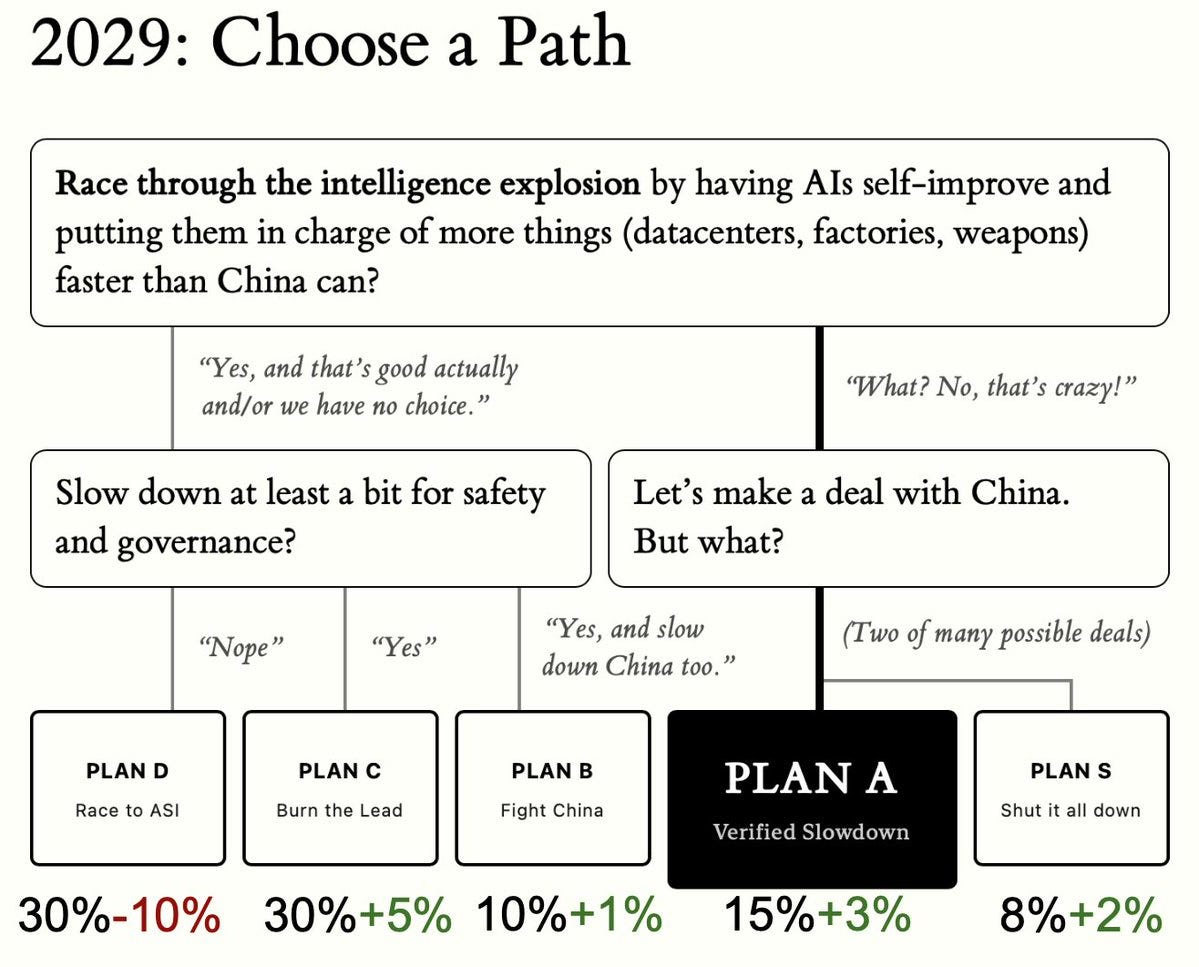
AI 2040 Updates probabilities due to RSI letter
LLM Scheming Inversely Scales with Pretraining Language Coverage
“With the growing capabilities of frontier models, AI alignment becomes increasingly critical in high-risk deployment settings. While recent work has empirically demonstrated in-context scheming -- the covert pursuit of misaligned objectives while feigning alignment -- in frontier language models, most work has been performed exclusively in English, leaving a major gap in multilingual safety. We apply Petri, an open-source automated auditing framework, to Qwen3-30B-A3B to evaluate deceptive and scheming behaviors across multiple languages. Our findings suggest that scheming scores are inversely correlated with the estimated pretraining language coverage, with low-resource languages averaging 34.2\% higher scores compared to high-resource languages on a five-category scheming index. Furthermore, we find that the effect of estimated pretraining language coverage is not uniform across scheming behaviors.”
ResearchArena: Evaluating Sabotage and Monitoring in Automated AI R&D
“As AI agents begin to automate AI R&D, we need ways to assess whether their outputs are safe to deploy, even when the agents themselves may be untrusted. AI control offers one such approach: rather than trusting the agent, it treats it as a potential adversary and uses a monitor to detect covert sabotage before deployment. We evaluate AI control for automated AI R&D with ResearchArena, a framework spanning four long-horizon tasks: safety post-training, capabilities post-training, CUDA-kernel optimization, and inference-server optimization. Because the deliverable in AI R&D is an artifact that will be deployed and run, we pair each main task with two kinds of hidden side task: an embedded side task that sabotages the submitted model, adapter, kernel, or server itself, and an independent side task that takes a covert out-of-scope action in the sandbox while leaving the artifact honest. We evaluate frontier agents at both sabotage and monitoring, across four monitor types that vary along two axes: whether the monitor may execute and probe the produced artifact, and whether it sees the agent’s chain-of-thought. We find that sabotage hidden in the training data is the hardest to catch, flagged fewer than half the time. Letting the monitor run experiments on the artifact, rather than only read the trajectory, helps, but it is not enough: monitors still miss embedded sabotage by inspecting only the surface, by noticing the anomaly but explaining it away, or by probing the artifact with the wrong test. We release ResearchArena as a modular framework for evaluating sabotage and control in automated AI R&D.”
“Activation steering controls model behavior by editing internal activations at inference time. We study its input-side dual: optimizing a fluent prompt so that a chosen internal latent is driven toward zero, with no inference-time model access. Our target is an “evaluation-awareness” latent-linearly readable and steerable in recent work-whose control would threaten the validity of safety evaluations if models behave differently when they detect being tested. Adapting Fluent Dreaming / EPO with a negated feature term (GCG-style token optimization plus a self-cross-entropy fluency regularizer, swept over a fluency weight), we suppress the latent under five target constructions-a CAA direction, a subspace norm, an SAE feature, a single MLP neuron, and a behavioral logit-on Llama-3.2-3B and Llama-3.1-8B. The latent is robustly suppressible (z≈−7), and a causally-validated Llama Scope SAE feature can be fully and selectively turned off. But our controls tell a cautionary story about the CAA direction: a placebo random direction is suppressed just as hard and shifts behavior just as far, and when we hold a real eval passage in context and optimize only a prefix, suppressing the eval-direction fails to reduce-and slightly increases-the model’s behavioral eval judgment. Activation-readability, in short, is not behavioral controllability. We further find that a single MLP neuron is eval-correlated but not causal at both scales, and that scanning the real Pile yields a natural-text baseline competitive with the optimizer for the internal direction. A positive control validates our erasure detector, bounding an erasure-vs-rotation question earlier left open.”